Buying ready-to-wear clothing online should make getting dressed easier, not leave you wondering whether you ordered the right size.
When shopping for a ready-to-wear kurta or 2-piece suit, it is tempting to choose the same size you normally wear. But a Small from one brand may not fit exactly like a Small from another. Even within the same brand, different silhouettes can have different measurements.
That is why the best way to choose your ready-to-wear size is to look beyond the size label.
Check out RAWA ready-to-wear collection
Your bust, waist, hip and shoulder measurements, together with the intended fit of the garment, give you a much better idea of which size to choose.
In this guide, we will explain how to measure yourself, how to read a ready-to-wear size chart, how much room a kurta should have and what to do when you are between two sizes.
Why Ready-to-Wear Sizes Can Be Confusing
Ready-to-wear clothing is made in predetermined sizes rather than being individually stitched to your measurements.
The letters may look familiar. XS, S, M, L and XL are widely used, but the actual measurements behind those labels can vary between brands and garments.
For example, Khaadi publishes garment measurements for individual kurtas, including length, shoulder, chest and sleeve length. Sapphire similarly provides detailed measurements for individual ready-to-wear shirts, while Nishat Linen provides measurements for individual pret pieces.
This means your usual size is a useful starting point, but it should not be the only thing you consider.
The better question is:
Which size has measurements closest to what I need?
Don’t Rely On S, M, L Or XL Alone
The size label tells you very little without the measurements behind it.
A Small may work perfectly in one relaxed kurta but feel different in a more structured shirt. Similarly, a Medium may give you the right bust room in one style while being unnecessarily loose in another.
This is especially important when buying clothing online because you cannot try the garment on before ordering.
Before selecting your size, check the product’s size chart and compare it with your own measurements or with a garment you already own and love the fit of.
This is also why RAWA will provide product-specific sizing information rather than asking you to rely only on the letter printed on the label.
How To Measure Yourself For Ready-to-Wear
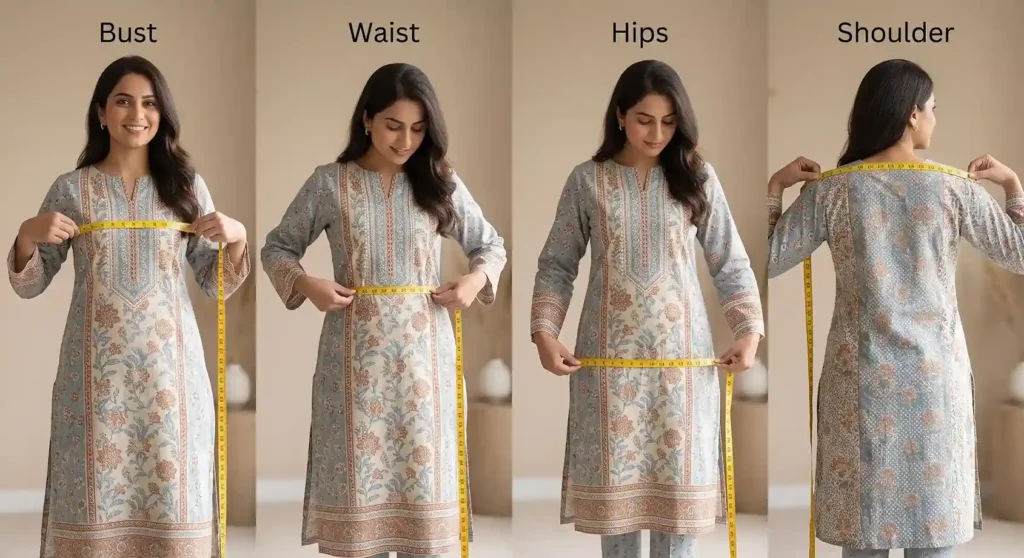
You do not need complicated equipment to take your measurements.
All you need is a flexible measuring tape and a few minutes.
For the most useful results, measure yourself while wearing light clothing. Keep the measuring tape comfortably against your body without pulling it tightly.
Stand naturally and avoid holding your breath or changing your posture while measuring.
The most useful measurements for a ready-to-wear kurta or suit are your bust, waist, hips and shoulders.
1. Measure Your Bust
Wrap the measuring tape around the fullest part of your bust.
Keep the tape level across your back and make sure it is not too tight.
The tape should sit comfortably against your body without compressing your bust.
Your bust measurement is particularly important when choosing a kurta because insufficient room can cause pulling across the front, while excessive room can make the garment look much looser than intended.
2. Measure Your Waist
Measure around your natural waist, usually the narrowest part of your torso.
Do not pull the tape tightly.
Although waist measurement can be less critical for a loose kurta, it becomes more important for fitted shirts and trousers.
3. Measure Your Hips
Measure around the fullest part of your hips.
This measurement is especially useful when choosing trousers, pants or a straight-cut kurta that needs sufficient room around the lower body.
If the shirt is designed with a relaxed or A-line silhouette, the hip measurement may be less restrictive. However, it is still useful when deciding between sizes.
4. Measure Your Shoulders
Measure across your back from one shoulder point to the other.
Shoulder width is one of the most overlooked measurements when buying ready-to-wear clothing.
A garment can have enough room around the bust but still feel uncomfortable if the shoulders are too narrow.
The shoulder seam should generally sit close to your natural shoulder point unless the garment has been intentionally designed with a dropped or oversized shoulder.
How To Choose Your Ready-to-Wear Size
Once you have your measurements, compare them with the size chart provided for the garment.
Do not automatically select the size you usually buy.
Instead, look at the measurements and consider how the garment is designed to fit.
For example, if your measurements are closest to Medium but the garment is intentionally oversized, you may prefer a smaller size depending on the design.
If the garment is more fitted, you may need more room through the bust and shoulders.
The product description can also provide useful information about the intended silhouette.
Look for descriptions such as:
Straight fit
A relatively clean and consistent shape through the body.
Relaxed fit
More room through the body for a comfortable, less structured appearance.
Oversized fit
Designed intentionally with additional volume and ease.
A-line
Usually narrower around the upper body and gradually wider toward the hem.
The important thing is to understand that the same size label can look different depending on the cut.
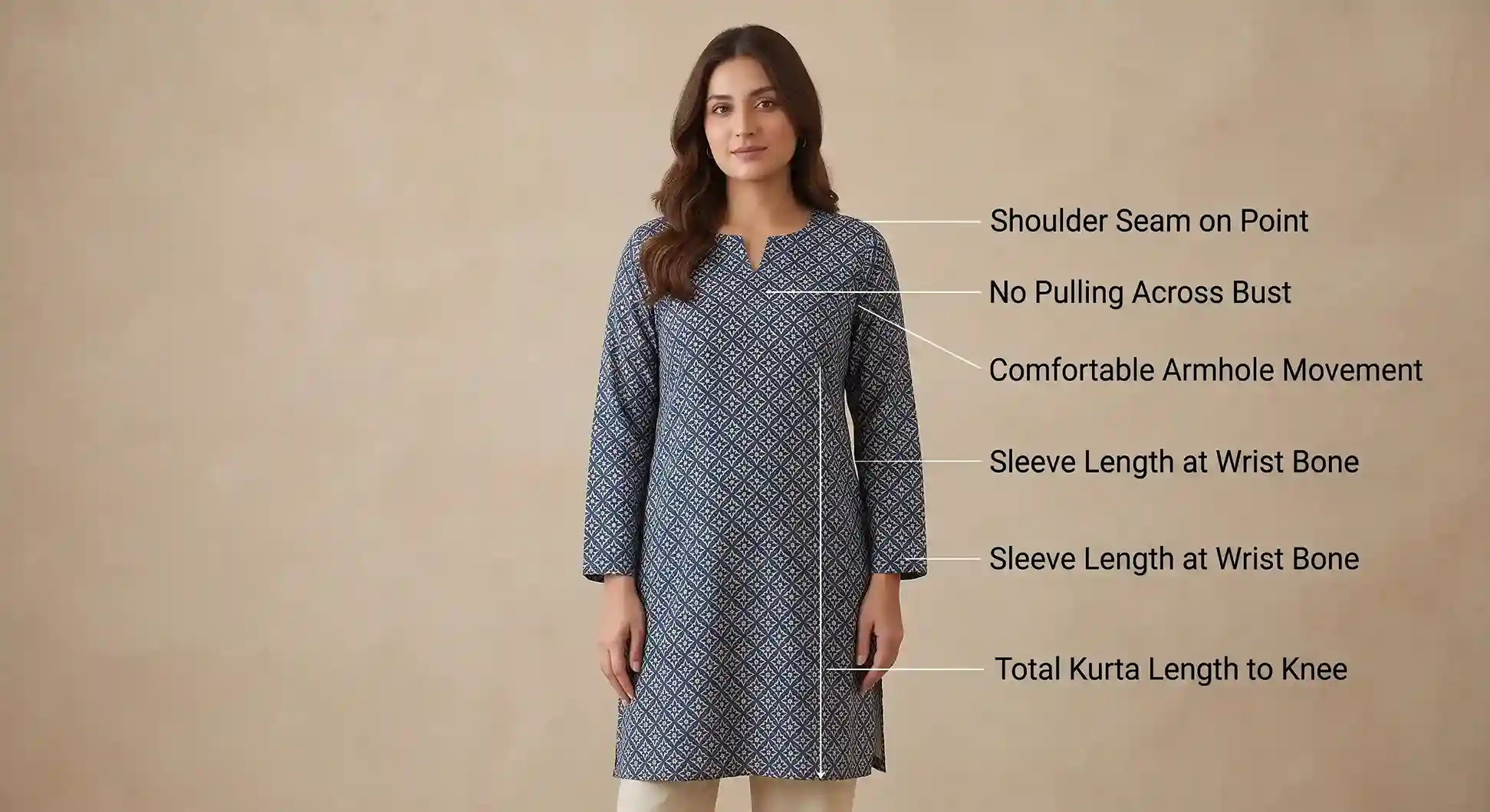
How Should A Kurta Fit?
A well-fitting kurta should feel comfortable while still looking intentional.
It should allow you to sit, walk, reach and move your arms without feeling restricted.
There should not be excessive pulling across the bust or shoulders. At the same time, the garment should not have so much extra fabric that the intended silhouette is lost.
Here are the main areas to check.
Shoulders
The shoulder seam should sit close to your natural shoulder point on a standard-cut kurta.
If the seam sits significantly beyond your shoulder, the garment may be too large unless the design is intentionally relaxed or oversized.
If the seam pulls inward or feels restrictive, you may need more room.
Bust
The fabric around your bust should fall smoothly.
Horizontal pulling, stretched seams or visible strain can indicate that the garment is too small.
A small amount of ease allows you to move comfortably without making the garment look loose.
Armholes
You should be able to raise and move your arms without the garment pulling uncomfortably across the underarm and shoulder.
This is particularly important for everyday clothing because a kurta that looks good while standing still but restricts movement will quickly become uncomfortable.
Sleeves
Sleeves should allow natural movement without feeling excessively tight around the upper arm.
The ideal sleeve length depends on the design. Full sleeves, three-quarter sleeves and shorter sleeves each create a different proportion.
Kurta Length
Length is an important part of how a kurta looks.
A shorter kurta creates a different silhouette from a longer straight kurta or an A-line style.
Your height, the trouser style and the intended design all influence what length looks balanced.
There is therefore no single kurta length that works for everyone.
Instead, look at the garment’s actual length in the product size chart and compare it with a kurta you already own.
Check out RAWA 2-piece suits
How Much Ease Should A Kurta Have?
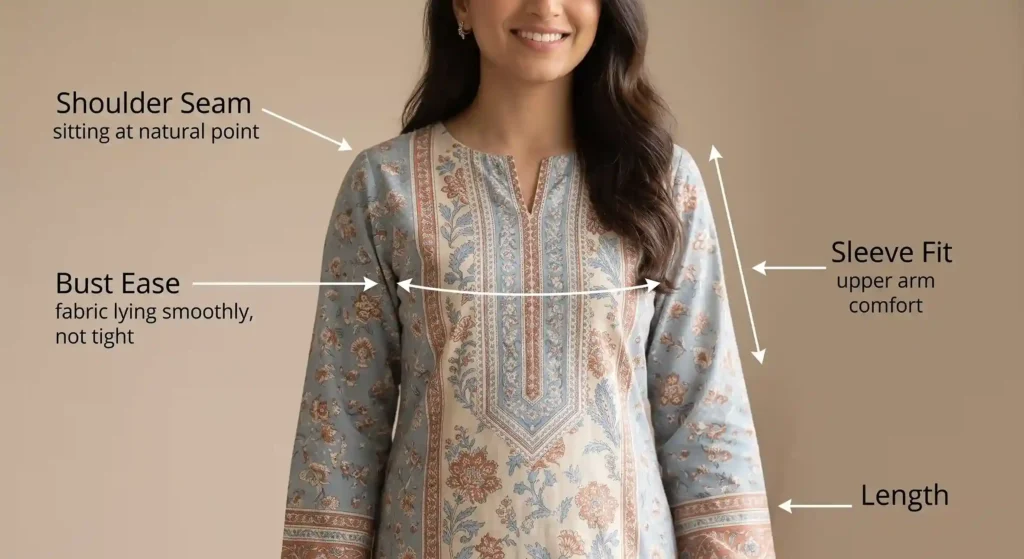
Ease is the extra room built into a garment beyond your body measurements.
You need some ease in a ready-to-wear kurta because clothing needs to move with your body.
The amount of ease depends on the design.
This is why simply adding a fixed number of inches to your body measurement does not work for every garment.
The garment’s intended silhouette matters just as much as the measurement itself.
What If You Are Between Two Sizes?
Being between two sizes is completely normal.
If your measurements fall between two sizes, first consider the garment’s fit.
For a relaxed or loose-fitting kurta, the smaller size may provide the look you want if the bust, shoulders and armholes still have enough room.
For a more fitted style, the larger size may provide greater comfort, particularly around the bust and shoulders.
You should also consider which measurement is most important for the particular garment.
When shopping online, always check the individual product’s measurements before making the final decision.
A Simple Way To Choose Your Size
If you already own a ready-to-wear kurta that fits you perfectly, there is another useful method.
Lay the garment flat on a bed or clean surface.
Measure key areas such as the shoulder, chest, sleeve and length.
Then compare those measurements with the product’s size chart.
This can sometimes be easier than trying to remember your body measurements because you are comparing the new garment with something you already know fits you well.
Just remember that a garment measurement and a body measurement are not the same thing.
The garment normally includes additional room for ease.
Check The Fit When Your Order Arrives
When your ready-to-wear order arrives, try it on before removing tags or washing the garment if your retailer’s exchange policy requires the item to remain in its original condition.
- Stand naturally in front of a mirror.
- Check the shoulders first.
- Then look at the bust, armholes, sleeves and overall length.
- Move your arms, sit down and walk around.
- The right size should not only look good while standing still. It should feel comfortable during normal movement.
Also check whether the garment looks like the intended silhouette.
A relaxed kurta should look relaxed.
A straight kurta should maintain its clean shape.
An oversized design should look intentionally oversized rather than simply too large.
Common Ready-to-Wear Sizing Mistakes
Choosing Your Usual Size Without Checking The Chart
Your usual size is a useful reference, but different brands and garments can use different measurements.
Measuring Yourself Too Tightly
Pulling the tape tightly against your body can give you measurements that are smaller than they should be.
Ignoring Shoulder Measurements
A shirt can have enough bust room and still feel uncomfortable if the shoulders are too narrow.
Looking Only At Bust Measurement
Bust measurement is important, but it is not the only factor. Shoulder, hip, sleeve and garment length can all affect the final fit.
Assuming Every Garment Has The Same Fit
A relaxed kurta and a fitted shirt should not be expected to fit the same way.
Always consider the garment’s intended silhouette.
Choosing A Size Based Only On The Letter
S, M, L and XL are labels.
The actual measurements are what help you understand the fit.
How RAWA Approaches Ready-to-Wear Sizing
At RAWA, we want choosing your size to feel straightforward.
Our ready-to-wear pieces are designed with everyday wear in mind, so comfort is an important part of the fit.
Every RAWA product should be checked against its individual size information before ordering. Because different designs can have different silhouettes and proportions, the measurements provided with the product are more useful than relying on the size label alone.
If you are unsure between two sizes, compare the product measurements with a garment you already own and like wearing.
Our goal is simple.
You should know what you are ordering before it arrives at your door.
For more information, see our [RAWA Size Guide] and check the measurements listed on each product page before placing your order.
Final Thoughts
Choosing the right ready-to-wear size does not have to be complicated.
And when possible, compare the measurements with a garment you already own and love.
The right size is not necessarily the size you usually buy.
It is the size that gives you the right combination of fit, comfort and proportion for the garment you are choosing.